File System
All tracks on the floppy disks have the same format as shown in the figure below. The track consists of alternating ‘0x9e’ blocks and ‘0x9b’ blocks. These are alse referred to in the Q1 documentation as id records and data records.
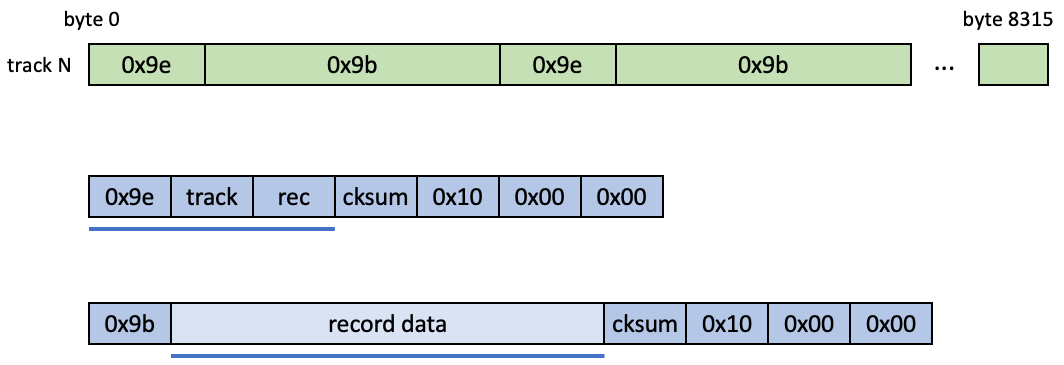
Q1 floppy disk format. Blue lines show the fields that are included in the checksum.
The ID record is always seven bytes long and consist of 0x9e followed by the track number, the record number, the checksum, and the trailing bytes 0x10, 0x00, 0x00.
The data record starts with 0x9b followed by N bytes of application data, followed by the checksum and the trailing 0x10, 0x00, 0x00.
The trailing 0x00’s are not used/address when reading a record from the disk. However, for write operations these zeroes are written to disk.
Note
There is an inconsistency of the checksum, which covers 0x9e for id records but excludes 0x9b for data records. This caused me a lot of frustration and kept me from progress for several days.
There are three distinct types of data records: INDEX files, program files and (generic) data files.
All data records on a track have the same size called the record size. The record size is the size, N, of the application data (light blue in the figure). Thus is does not include the 0x9b, the checksum or the trailing bytes.
Record sizes can range from 1 byte to 255 bytes.
The lowest record size seen so far is 20 bytes and the highest is 255.
INDEX
The index files reside on track 0 (also names INDEX) and contains information about the disk layout.
The record size is 40 bytes and its layout is described in Q1 ROS Users Manual p. 18:
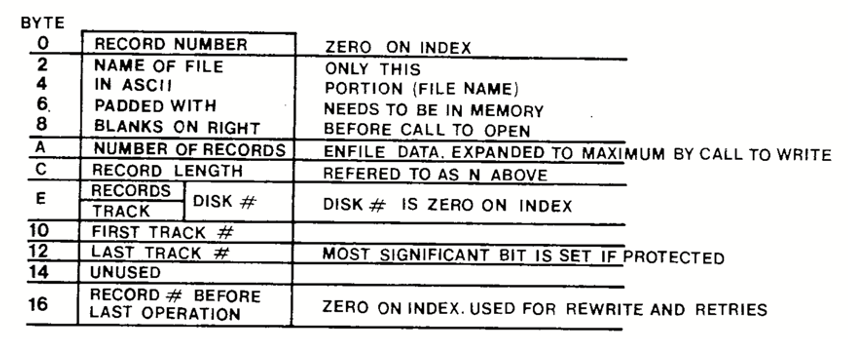
File description only uses 24 bytes of the 40 available. The rest is typically zeroed.
Program files
These are executable programs. Record sizes are 255 and multiple tracks may be used.
A loadable file consists of consecutive sequences of blocks. The maximum size for a block is 255. Each block consists of a one-byte block separator, a two-byte load address, a one-byte length field and M bytes of data. The separator can have any value except 0 which marks the end of the data in that record.
Note
It seems possible to load zero bytes at a specified address.

Loader record format.
Loading a program will then be a sequence of actions like
load 40 bytes at 0x9000
load 20 bytes at 0x9040
load 100 bytes at 0xa100
etc.
For an executable program, the last block typically loads two bytes at address 0x4081. Address 0x4080 contains a jump (jp) opcode and combined with the two loaded bytes this jumps to the entry point for the loaded program (ROS Users Manual p.2).
The following is an example retrieved from the SCR program (z80 assembler) which only occupies a single record of track 1.
Track 1, Record 0
separator 0x0d: load 111 bytes into address 0x4300
4300 f3 3e 00 d3 0a 3e 05 d3 04 16 00 7a d3 03 14 7a  .>...>.....z...z
4310 fe 80 ca 36 43 2e ff 2d c2 17 43 db 01 fe 00 ca  ...6C..-..C.....
4320 0b 43 fe 0e ca 0b 43 fe 0f c2 0b 43 db 01 fe 0e  .C....C....C....
4330 c2 2c 43 c3 0b 43 21 42 43 0e 03 06 2d ed b3 c3  .,C..C!BC...-...
4340 09 43 20 20 20 20 20 20 20 20 20 20 20 20 20 54  .C             T
4350 48 49 53 20 53 50 41 43 45 20 46 4f 52 20 52 45  HIS SPACE FOR RE
4360 4e 54 20 20 20 20 20 20 20 20 20 20 20 20 20     NT

separator 0x0d: load   2 bytes into address 0x4081
4081 00 43
So the entry point for SCR is at address 0x4300. The loader will call address 0x4080 to start the program:
> 4080 C3 00 43 ; jp 0x4300
Generic data files
No other files appear to have special interpretation, but record sizes may be imposed by other applications.
For example PL/1 source code have record sizes of 79 bytes corresponding to (the maximum allowed?) size of a code line. Generic files with record size 255 are allowed, but loadable files must have record size 255 as far as I can tell.